Blog

Who is afraid of AI? Who should be?
If you follow current debates, you might think that everyone should be afraid of AI.
Or no one. Or only “the others.”

A recent policy brief by the Kiel Institute for the World Economy takes a more differentiated – and refreshingly evidence-based – view.

Here some insights from a knowledge management perspective:

  1. Exposure is not the same as replacement:
    One of the most important clarifications in the study is also one that is often missing in discussions: “Exposure to AI … indicates the potential applicability of AI to an occupation’s tasks — it is not inherently a measure of substitution or complementarity.”
    In other words:
    Just because AI can do parts of your work does not mean it will replace you.
    For knowledge work, this is a crucial distinction. Even in organisations where AI is already deeply embedded it does not necessarily reduce headcount. Instead, we see shifts in how work is done and what kind of knowledge becomes critical.
  2. Surprise(?): High-skilled knowledge workers are most exposed
    The study shows a pattern that is different from previous economic transformations: Highly cognitive, non-physical, low-social-interaction jobs (e.g. analysts, developers, translators) are most exposed to AI. Whereas, jobs requiring manual skills or intensive interpersonal interaction are least exposed.
    It is not the “low-skilled” jobs that are immediately most affected – it is classic knowledge work.
    From a KM perspective, these are precisely the domains where structured knowledge, explicit processes, and codified expertise already exist – making them easier for AI to engage with. Or following Willkes definition of knowledge work it is the knowledge-intense work (not the actual knowledge work).
  3. No (immediate) job loss – but skill shifts
    The empirical results across Denmark, Portugal, and Sweden are remarkably consistent:
    – No significant negative effect on total employment
    – Clear shift towards higher-skilled work (“skill upgrading”)
    Firms exposed to AI “raise their high-to-low skill employment ratios” and reallocate toward high-skill white-collar jobs.
    This fits closely with what many of us observe in practice:
    Routine documentation is automated, analytical work is accelerated. But interpretation, integration, and contextualisation become more important.
    Or, in KM terms: We are moving from information processing to meaning-making (from explicit to tacit).
  4. The overlooked dimension: social and tacit knowledge
    A particularly interesting methodological choice in the study is the inclusion of social skills as a counterweight to AI exposure:
    Social tasks are assumed to be more difficult to automate. This aligns strongly with long-standing KM insights:
    Tacit knowledge is hard to codify.
    Social interaction is key to knowledge creation (think SECI…).
    Context and trust cannot easily be replicated by systems.
    If you connect this to earlier discussions on this blog (e.g. on knowledge transfer during offboarding or peer-based formats like Peer Assist), a clear conclusion emerges:
    What protects jobs is not the absence of AI—but the presence of social, contextual, and experiential knowledge work.
  5. Not all AI is the same – and that matters
    Another important nuance in the study: Different AI subdomains have different effects. In particular: Language modelling, speech recognition, reading comprehension show positive associations with employment across all skill groups.
    This is highly relevant for organisations currently introducing generative AI: These systems are not only automation tools – they are collaboration technologies. They amplify communication, documentation, and coordination – core KM processes, if used correctyl and not as a Google 2.0.

What does this mean for knowledge management?

If we step back, the findings point to a shift in the KM agenda.

From:

  • Capturing knowledge
  • Structuring information
  • Reducing redundancy

To:

  • Enabling skill development
  • Supporting AI-augmented workflows
  • Strengthening social knowledge processes

Or more provocatively:
The real risk is not that AI replaces knowledge workers.
The real risk is that organisations fail to redefine knowledge work.

So, who should be afraid?

The answer from the study is clear: It depends on the tasks you perform.

Be concerned if your work is:

  • Highly standardised
  • Easily codified
  • Low in social interaction

Be optimistic if your work involves:

  • Interpretation and judgment
  • Cross-context integration
  • Collaboration and sensemaking

However, AI does not primarily eliminate work. It reshapes the skill profile of work. Which is not a surprise, is it?
But what are the implications for knowledge management?

  • We need better ways to develop and transfer higher-order skills.
  • We need to redesign knowledge processes for human–AI collaboration.
  • And we need to take tacit and social knowledge more seriously than ever.

Because in the end, the question is: Who is prepared to work differently with knowledge?

And another question that arises from this is: What does this mean for young people entering the workforce?
To be continued.
Das Münchner Haus des Wissens

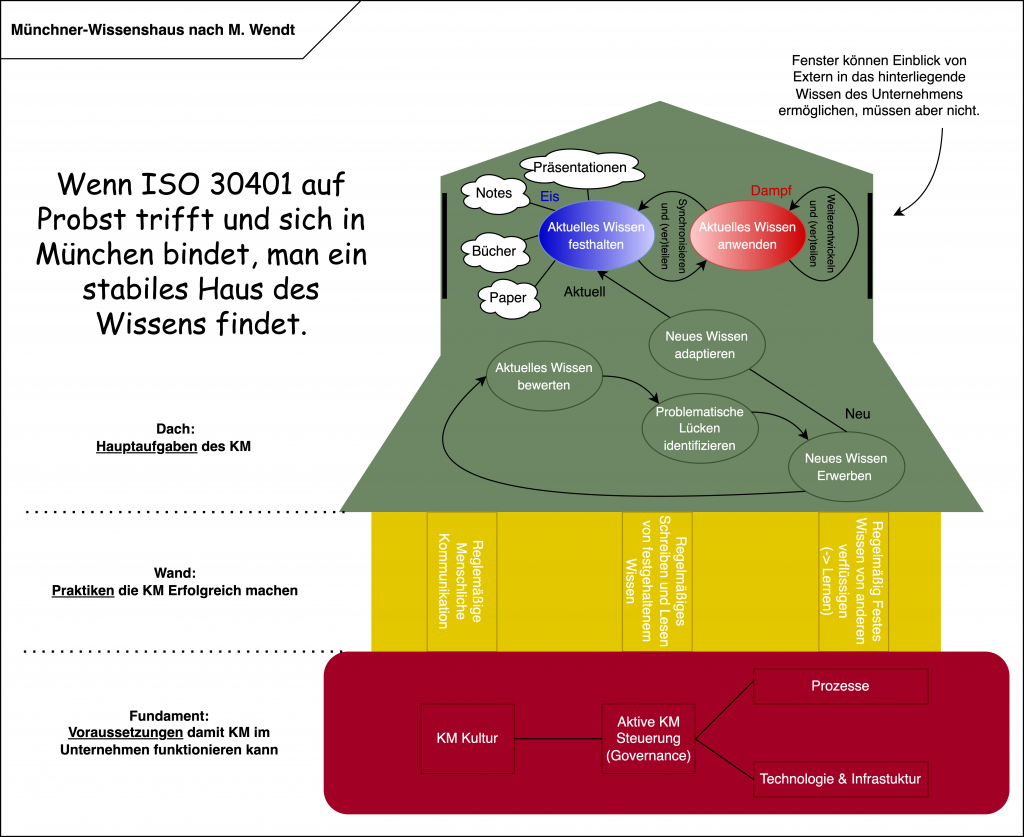
Wie im letzten Blogpost bereits berichtet, erstellen die Studierenden meiner Lehrveranstaltung Wissensmanagement-Modelle und -Strategien am Center for Advanced Studies der Dualen Hochschule Baden-Württemberg (DHBW) ein kurzes Erklärvideo oder ein Icon/ eine Visualisierung zu einem Konzept aus dem Wissensmanagement.

Maximilian Wendt ist dabei kreativ übers Ziel hinausgeschossen und hat anstelle einer einfachen Visualisierung gleich ein Modell für Wissensmanagement erstellt: sein Münchner Haus des Wissens (München, weil sich im oberen Stockwerk Anklänge an das Münchner Modell nach Reinmann finden). Andere Inspirationsquellen von Max finden sich im kleinen einleitenden Reim.

Auch dieses wunderbare Arbeitsergebnis dieser kleinen Studienaufgabe wollte ich euch nicht vorenthalten. Ich finde es sehr inspirierend. Vielen Dank, Max!

Unlearning vs Forgetting

Als so genannte Vorprüfungsleistung meiner Lehrveranstaltung Wissensmanagement-Modelle und -Strategien am Center for Advanced Studies der Dualen Hochschule Baden-Württemberg (DHBW) erstellen die Studierenden ein kurzes Erklärvideo oder ein Icon/ eine Visualisierung zu einem Konzept aus dem Wissensmanagement.

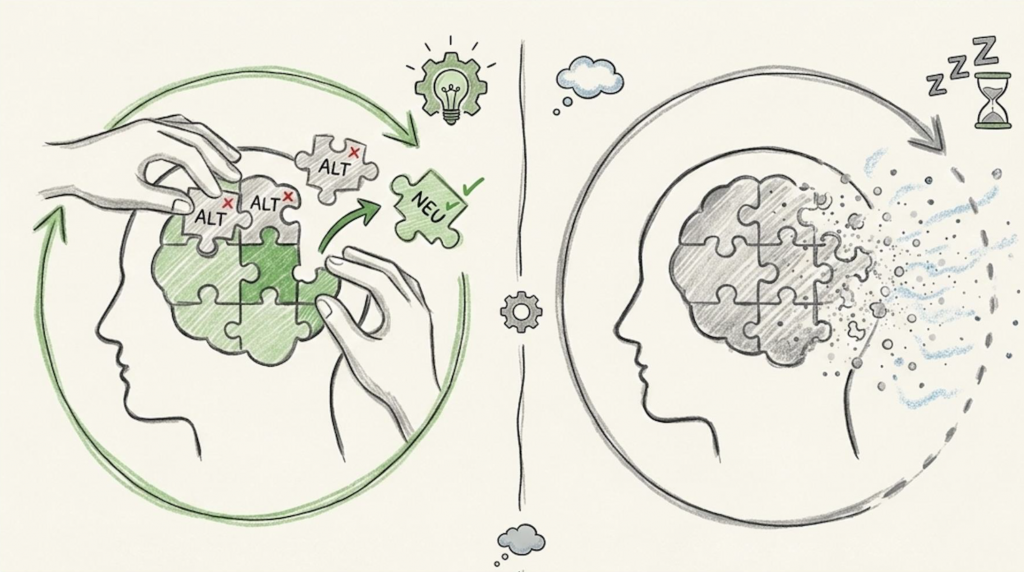
In diesem Semester haben Nils Weber und Maximilian Fetzer gemeinsam das Konzept der Unlearning Organisation visualisiert, und zwar im Gegensatz zur Forgetting Organisation. Das ist ihnen sehr gut gelungen, weshalb ich ihre Visualisierung hier gerne teile. Und weshalb ich nun auch gar nichts weiter zu den Konzepten Unlearning und Forgetting sage, weil sich dies aus dem Bild einfach erschließt.

Vielen Dank für die Erlaubnis zur Veröffentlichung, Nils und Max!

Good AI Practice in Drug Development (cont.)

In my previous post, I argued that the medical technology sector offers valuable lessons for building reliable AI systems—particularly through Good Machine Learning Practice (GMLP). With the “Guiding Principles of Good AI Practice in Drug Development”, jointly published by the European authority EMA and the US-american FDA in January 2026, this perspective is extended beyond medical devices.

These principles span the entire drug‑development lifecycle: preclinical research, clinical trials, and manufacturing. This expansion is not only regulatory in nature—it also has important implications for how organisations learn, govern knowledge, and stabilise expertise around AI.

Human‑centric by design: making responsibility explicit
The emphasis on human‑centric and ethical design reframes AI as a socio‑technical system rather than a purely technical artefact. Human oversight is no longer assumed; it is a design requirement.
From a KM perspective, this matters because it forces organisations to make responsibility, judgement, and decision authority explicit—and therefore learnable. Tacit assumptions about “what the system does” or “who decides in the end” no longer suffice. AI design becomes a vehicle for clarifying roles, expectations, and accountability structures that are central to organisational knowledge.

AI systems as part of the GxP (Good Practices in Pharma) knowledge landscape
The explicit requirement for GxP compliance positions AI systems firmly within the organisation’s regulated knowledge infrastructure.
For AI‑enabled computerized systems, e.g. analytical decision‑support systems, this implies:

  • structured data governance as a shared organisational memory (not just a technical safeguard)
  • quality management across the entire AI lifecycle, turning development, deployment, monitoring, and change into learning loops rather than isolated events

In KM terms, AI is treated as institutionalised knowledge—codified, governed, audited, and continuously maintained.

Proportionate validation as organisational sense‑making
The call for risk‑based, proportionate validation once again supports a move away from schematic compliance towards contextual judgement.
This aligns closely with organisational learning: validation becomes an ongoing process of sense‑making about risk, impact, and uncertainty, rather than a checklist exercise. Different AI systems require different depths of scrutiny—not because standards are weakened, but because learning is situated.

Performance beyond metrics: learning in use
By extending performance evaluation beyond isolated model metrics to include human–AI interaction, the principles acknowledge an old KM insight: systems only reveal their quality in practice.
Interpretability and explainability are not technical luxuries; they are prerequisites for:

  • shared understanding
  • justified trust
  • reflective use

An AI system that cannot be meaningfully explained cannot become part of an organisation’s collective knowledge—no matter how accurate it is.

Plain language and monitoring: sustaining knowledge over time
Two further aspects strengthen the learning dimension.
First, the requirement for plain‑language communication treats understanding as a quality attribute. Knowledge about AI functionality, limits, and changes must be accessible—not only to experts, but to users and, where relevant, patients.
Second, the focus on continuous monitoring and data drift reinforces the idea that AI systems are never “finished”. They evolve with their context. Managing them therefore means learning over time, detecting change, and deliberately updating both models and organisational understanding.

My conclusion:
Seen through a KM lens, the EMA–FDA principles do more than regulate AI. They provide a framework for embedding AI into organisational learning structures – through transparency, lifecycle thinking, and explicit responsibility. Reliable AI, in this sense, is not primarily a technical achievement. It is the outcome of organisations that are able to learn about their systems, their data, and their own practices—continuously and collectively.

What We Can Learn from Medical Technology Industry About Reliable AI

It is quite rare for my two main areas of consultancy – knowledge management and computerised system validation in the pharmaceutical sector – to overlap, but when it comes to AI…

Whilst many companies are still experimenting with prototypes, the medical sector has already established a strict framework for the safe use of these technologies: Good Machine Learning Practice (GMLP).
These ten principles, developed by leading regulatory bodies such as the FDA (US Food and Drug Administration) and the IMDRF (International Medical Device Regulators Forum), provide a blueprint for robust and trustworthy AI systems, not only in the regulated field of medical technology.

Here are the key GMLP principles:

  1. Interdisciplinary teams rather than siloed solutions
    An AI model is only as good as the understanding of its intended purpose. GMLP requires experts from various disciplines to collaborate throughout the entire lifecycle. Engineers, data specialists and the actual end-users must work together to define the clinical or business benefits the AI is intended to deliver, as well as the risks involved.
  2. Sound software engineering and security
    AI is software – and should be treated as such. This means consistently applying best practices in software engineering, cybersecurity and risk management. A methodical design process ensures that decisions are traceable and that the integrity and authenticity of the data are maintained.
  3. Data quality and representativeness
    A common mistake in AI projects is a ‘bias’ in the data. GMLP stipulates that datasets must reflect the actual target population. If, for example, only data from a specific user group is used, the model will fail in the real world. Careful data governance is key here.
  4. Strict separation of training and test data
    To objectively evaluate a model’s performance, the training and test datasets must be strictly independent of one another. This prevents ‘label leakage’ – a phenomenon whereby the model ‘guesses’ the outcome based on hidden clues in the training data, rather than learning genuine patterns. Only through independent testing can it be demonstrated that the AI also works with new, unknown data.
  5. Suitability of reference standards
    Use of the best available (clinical) methods for generating reference data
  6. Tailored model design
    The model design must be suited to the available data and the intended use in order to minimise risks such as overfitting
  7. Focus on human-AI interaction
    In practice, AI rarely operates entirely independently. GMLP therefore focuses on the interaction between humans and machines. It is essential to ensure that users can interpret the AI’s outputs correctly and that no dangerous over-reliance on the system develops. Transparency and clear information about the system’s limitations are essential for this.
  8. (Clinically) Relevant test conditions
    Testing is carried out under conditions that simulate real-world clinical use
  9. Clear user information
    Users are provided with transparent information about the system’s capabilities, limitations and updates/re-training.
  10. Control does not stop after roll-out
    An ML model is not a static product. GMLP requires continuous monitoring of performance in real-world use (‘post-market monitoring’). This allows performance declines caused by changing data patterns (dataset drift) to be detected at an early stage and risks associated with retraining the model to be managed.

At first glance, applying these principles may seem like a lot of work. However, it is just necessary if we should build trust in AI, isn’t it? And for me the main message is: „It is the controlled data quality, stupid“.

KI, Kant und metakognitive Faulheit

KI, Kant und metakognitive Faulheit
erstellt mit Midjourney

Das Schöne an KI ist doch, dass wir anstrengende geistige Tätigkeiten an diese auslagern können. Eben nicht nur das Suchen nach Informationen, sondern – zu mehr oder weniger großen Anteilen – das Kreativ Sein, das Analysieren, das Problemlösen, das Nachdenken, kurz das Wissensarbeiten. Einige aktuelle Studien zeigen nun, dass Personen, die KI in dieser Form als ‚Mitdenker‘ nutzen, dazu neigen, ihre Arbeit, die mit der signifikanten Hilfe von KI entstanden ist, seltener zu prüfen und zu hinterfragen. Die Autoren einer dieser Studien (Beware of metacognitive laziness: Effects of generative artificial intelligence on learning motivation, processes, and performance) nennen dies „metakognitive Faulheit“.

Als Erwachsene können wir entscheiden, welche geistigen Prozesse wir an eine KI auslagern und wo wir uns bewusst dieser Faulheit widersetzen. Dazu nutzen wir unseren kritischen Verstand. Doch wie steht es um Kinder und Jugendliche, deren Mut sich des eigenen Verstandes zu bedienen – das Kantsche ’sapere aude‘ – gar nicht erst entwickelt wird, weil sie die anstrengende Reibung, die ein entsprechender Lernprozess bedeutet, vermeiden können?

Und was macht diese Entwicklung mit unserer Gesellschaft?

Unsere liberalen Demokratien beruhen auf mündigen Bürgern und Bürgerinnen, wie sie die Philosophen der Aufklärung beschreiben. Also Menschen, die sich ihres Verstandes bedienen und die Meinungen kritisch hinterfragen, auch ihre eigene. Wer nicht selbst denkt, wird alles glauben.

Und das, was wir da denken lassen, wird immer homogener, denn schließlich beruht generative KI auf Statistik und Wahrscheinlichkeit. „In großem Maßstab wird das, was als statistisches Musterlernen beginnt, zu einer generativen Kraft, die zentrale Tendenzen bevorzugt (…)“, so der Informatiker Zhivar Sourati.

Das Risiko, vor dem unsere Gesellschaften stehen, ist nicht die imaginäre Super-KI, die irgendwann die Weltherrschaft an sich reißt. Es ist unser selbst gewählter Weg in eine vor-aufklärerische Unmündigkeit – aus schierer Bequemlichkeit. Warum nur muss ich seit einiger Zeit immer wieder an den Animationsfilm Wall-E denken?

Vielleicht etwas pathetisch, aber ich ende mit einem hochaktuellen 300 Jahre alten Zitat:
„Aufklärung ist der Ausgang des Menschen aus seiner selbstverschuldeten Unmündigkeit. Unmündigkeit ist das Unvermögen, sich seines Verstandes ohne Leitung eines anderen zu bedienen. Selbstverschuldet ist diese Unmündigkeit, wenn die Ursache derselben nicht am Mangel des Verstandes, sondern der Entschließung und des Mutes liegt, sich seiner ohne Leitung eines anderen zu bedienen. Sapere aude! Habe Mut, dich deines eigenen Verstandes zu bedienen! ist also der Wahlspruch der Aufklärung.“

Neuer Workshop zu Kompetenzprofilen im Wissensmanagement

Neuer Workshop zu Kompetenzprofilen im Wissensmanagement
Sollprofil WM Professional

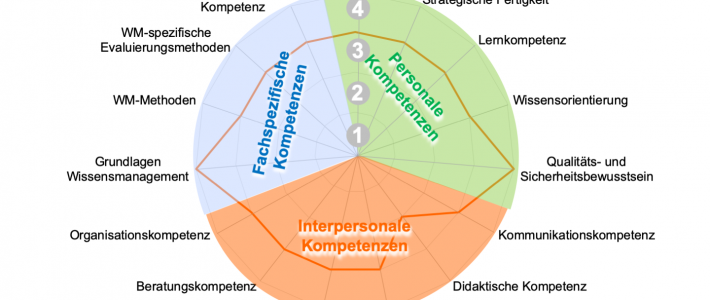
Am 23. April von 17 bis 19 Uhr biete ich nochmals gemeinsam mit Angelika Mittelmann, Sabine Wax und Ute John einen offenen Online-Workshop zur Entwicklung von Kompetenzprofilen im Wissensmanagement an. Dabei nutzen wir den von Angelika und mir entwickelten und gemeinsam mit Ute und Sabine weiterentwickelten GfWM Kompetenzkatalog.

Im Workshop werden wir in kleinen Arbeitsgruppen konkret Profile für Personae, also fiktive Personen, mit Rollen im Wissensmanagement erarbeiten. Diese Personae könnt ihr selbst mitbringen oder auch eine von uns vorgeschlagene nutzen. Durch die konkrete Anwendung werdet ihr den Kompetenzkatalog und dessen praktische Anwendung intensiv kennenlernen. Und wir erhalten von euch wertvolle Rückmeldung zum Katalog, aber auch zu Berufsbildern und Anforderungen im weiten Feld des Wissensmanagement.

Der Workshop ist kostenfrei. Bei Interesse bitte einfach bei mir melden!

Als kleine Vorbereitung könnt ihr euch mithilfe von ein paar knappen Erklärvideos schon einmal in den Kompetenzkatalog ‚eindenken‘ – müsst ihr aber nicht.

Wir freuen uns auf eine intensive Beschäftigung und Auseinandersetzung mit ‚Kompetenzen für Wissensmanagement‘.

Die KI denkt

Die KI denkt
erstellt mit Midjourney

Kürzlich habe ich in der Frankfurter Sonntagszeitung Folgendes gelesen: „Die KI [Claude Code] (…) kann jetzt einen Workflow von vier Schritten eigenständig abarbeiten: lesen, also unstrukturierte Informationen aufnehmen; denken, also domänenspezifisches Wissen anwenden; schreiben, also strukturierte Ergebnisse produzieren; verifizieren, also das Ergebnis mit mit vorgegebenen Standards abgleichen. In der Wissensökonomie gibt es nicht viele Berufe, die sich nicht auf diese vier Bausteine herunterbrechen lassen.“

Natürlich hat mich die Aussage zum Denken der KI nun selbst ins Nachdenken gebracht. Findet hier tatsächlich ein Denkprozess und eine Anwendung von Wissen statt – was ja voraussetzt, dass eine KI über Wissen verfügt.

Laut Philosophischem Wörterbuch von Georgi Schischkoff werden unter ‚Denken‘ alle (psychologischen) Vorgänge zusammengefasst, die aus einer inneren Beschäftigung mit Vorstellungen, Erinnerungen und Begriffen eine Erkenntnis zu formen versuchen. Martin Heidegger beschreibt das Denken gar als einen Weg. Das zu-Denkende entzieht sich dem Menschen und zieht ihn mit. Weil sich das zu-Denkende dem Menschen entzieht und sich von ihm abwendet, nimmt es ihn in Anspruch. 

Das kann mit dem Denken der KI nicht gemeint sein. Was also passiert, wenn eine KI „denkt“?
Hier verarbeitet das Modell die Informationen aus dem „Lesen“-Schritt und führt mehrere interne Teilprozesse aus:

  • Problemstruktur erkennen (Welche Aufgabe ist gestellt? Welche Informationen sind relevant?)
  • Hypothesen bilden durch statistisches Abwägen von Mustern aus Trainingsdaten
  • Lösungsstrategie planen (sinnvolle Schritte planen vor dem Schreiben)
  • Kontext verknüpfen durch die Kombination mehrerer Informationsquellen wie vorherige Nachrichten, bekannte Muster usw.

Das Denken einer KI bedeutet also interne Berechnungsschritte, probabilistische Planung, logische Strukturierung der Antwort. Das hat nichts zu tun mit Verstehen, Bewusstsein und intentionaler Überlegung, was das menschliche Denken kennzeichnet. Auch wird im eigentlichen Sinne kein „domänenspezifisches Wissen angewandt“, sondern die KI nutzt korrelationsbasierte Muster aus domänenspezifischen Trainingsdaten. Wir reden also von statistischer Generalisierung, nicht von Wissensanwendung.

Trotzdem ähnelt der Vier-Schritte-Workflow, mit dem bei modernen KI-Agenten typische Schwächen von Sprachmodellen, wie z. B. das Halluzinieren, reduziert werden, dem menschlichen Arbeitsablauf beim Problemlösen (z. B. nach Newell & Simon). Dadurch wird die KI vom reinen Textgenerierer zum Problemlöser.

Doch unser menschliches Denken ist soviel mehr als analytisches Problemlösen. Es ist auch zweckfreies Philosophieren, Träumen, Spintisieren… Ich denke, wir sollten uns angewöhnen, die technische Funktionsweise einer KI nicht mit menschlichen Begriffen wie ‚Denken‘ oder ‚Wissen‘ zu beschreiben, sondern angemessene technische Begrifflichkeiten dafür finden. Denn eine zunehmende Vermenschlichung von KI birgt das Risiko der abnehmenden kritischen Distanz. Und eine Vermenschlichung führt dazu, dass einer Technik Eigenschaften zugeschrieben werden, z. B. moralisches Verhalten, die für eine realistische Einschätzung technologischer Folgen letztlich irrelevant sind. Und den Blick ablenken von den verantwortlichen Menschen hinter der KI.

The parable of the learning flock of sheep

In my lectures on knowledge management, I have always enjoyed using the story of the learning flock of sheep – based on David Hutchens‘ story Outlearning the Wolves – to develop the characteristics of a learning organisation together with my students. Now my daughter Pauline has made a video out of it – without any AI, which I think makes it all the more beautiful.
Enjoy (duration 5’34 min.).

A German version is also available.