KM Competency Model: A guide for global practice
KMGN Research Community_202603
Looking forward to presenting our GfWM Catalogue of Competencies in the KMGN (Knowledge Management Global Network) Research Community.
Feel free to join.
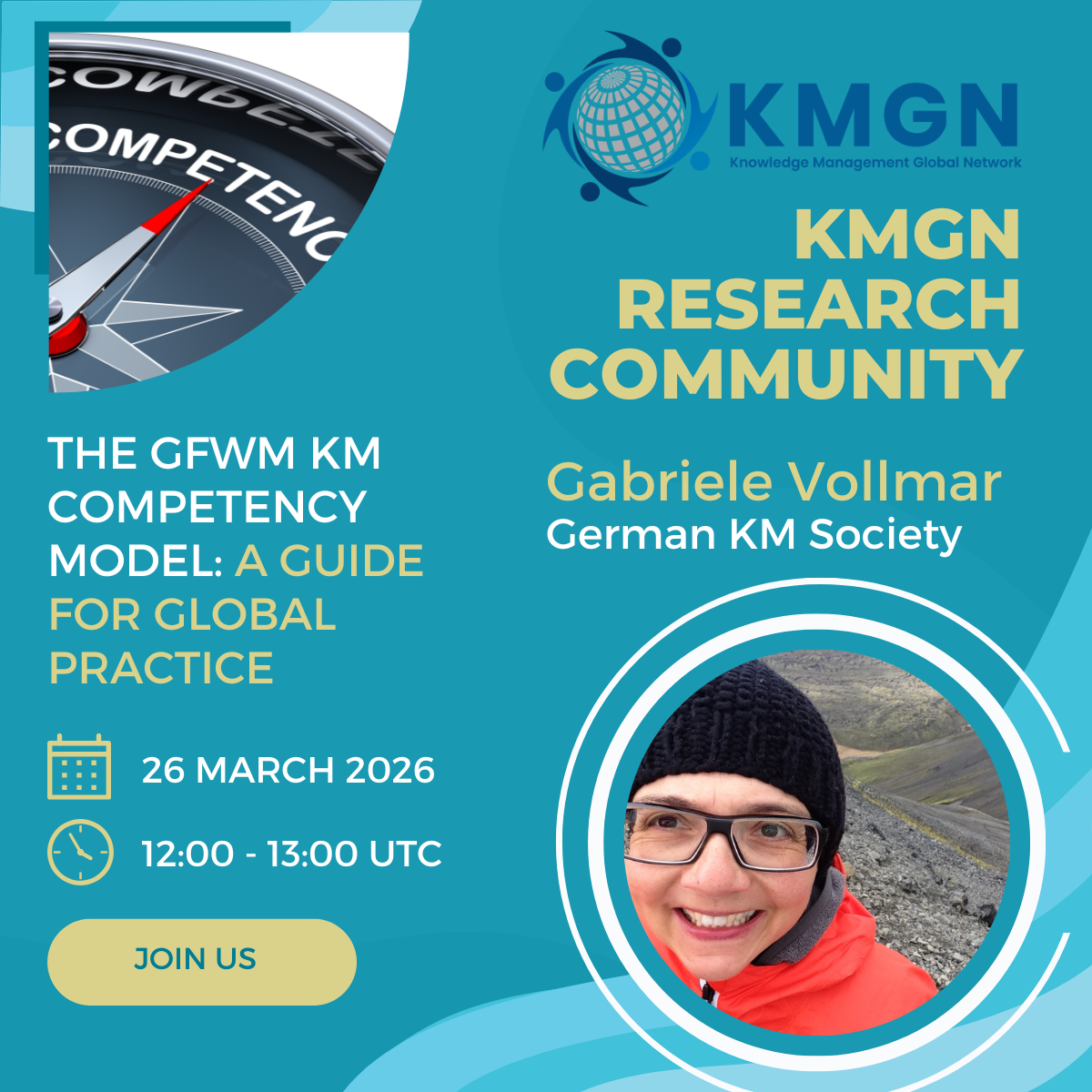
Looking forward to presenting our GfWM Catalogue of Competencies in the KMGN (Knowledge Management Global Network) Research Community.
Feel free to join.
In what is now the eighth episode of my short series on basic terms and concepts in knowledge management, I take a look at the so-called learning organisation: How does organisational learning differ from individual and collective learning? How does organisational learning manifest itself? What do single-loop, double-loop and deutero learning have to do with it? What are the five disciplines of the learning organisation according to Senge? And finally, what is absorptive and dissemination capacity all about?
Enjoy! (Duration 4’47 min.)
As always, my thanks go to Pauline Tempel for the successful visual implementation!
Another recording of a live session of our Knowledge Management MOOC (WMOOC) 2025 is now online. The only one in English at this year’s course. With this live session, we left behind the boundaries of the organization we usually operate within and looked at our topic of KM from a (global) political perspective. It was extremely interesting and stimulating. Thank you very much, Yannick! (Duration 43’40 Min.)
Da wir die Live Session der letzten Woche krankheitsbedingt verschieben mussten, gibt es in dieser Woche gleich zwei Sessions:
Thema 1: From Forecast to Expertise mit Yannick Vogt (Bakboka AG), die Session ist in englischer Sprache.
Yannick ist Mitgründer der Bakboka AG in Zürich, die zukünftige Ereignisse mithilfe einer Expertengemeinschaft antizipiert und dafür die Beobachtungen, Analysen und Prognosen von Experten nutzt, um Veränderungen in fragilen Ländern und Schwellenmärkten zu erkennen. Yannick, der aktuell in Kenia lebt, wird darüber berichten, warum es schwierig ist dieses expert knowledge zu interpretieren und wie der Weg von “Rohdaten” über eine interpretierte Analyse hin zu Wissen führt, auf dessen Grundlage Entscheidungen getroffen werden können.
Termin: Mittwoch, 3. Dezember, 17 Uhr
Thema 2 (verschoben von 27.11.): The Art of Unlearning: Warum Organisationen nicht nur Wissen aufbauen, sondern auch bewusst Überholtes loslassen müssen mit Janine Bauer (Transformation Mindset), die Session ist in deutscher Sprache.
Janine ist UNLearning Facilitator und Digital Learning Manager und reflektiert gemeinsam mit uns die Rolle von Unlearning im Wissensmanagement: Was macht Loslassen so schwer – individuell und organisatorisch? Wie kann Unlearning im Alltag und in der Organisation gelebt werden?
Termin: Donnerstag, 4. Dezember, 16 Uhr
Wie immer stehen die Live Sessions allen Interessierten offen, auch denen die (noch) nicht für den WMOOC registriert sind. Bei Interesse bitte einfach bei mir melden, dann schicke ich die Einwahldaten zu. Oder am besten gleich für den WMOOC Newsletter anmelden!
Interesting AI supported knowledge work workflow based on a simple model for knowledge work where the emphasis is on improving the quality of the input and not on speeding up the processing part.
Hand on heart: How often when you use the convenience of an AI do you think about the enormous effort behind it?
The AI Anatomy Map is an exploded view diagram that combines and visualizes three central, extractive processes that are required to run a large-scale artificial intelligence system: material resources, human labor, and data using Amazon’s Echo as example. It is worth a deep dive:

Go to the original website to see the picture in full scale.

Last week I attended a really inspiring talk held by Patrick Cohendet (HEC Montreal), organized by the Research Network of the KMGN: Knowledge Based Approaches to The Firm: An Idea-Driven Perspective.
What I really liked and what was an excellent food for thought was the conception of Knowledge Management as a bridging funtion between the Generating of (many) Ideas and the Innovation Management. Knowledge Management facilitates the evaluation and filtering of ideas by ensuring that during this process relevant knowledge is available and efficiently used:
„[…] an idea needs to be equipped with various bodies of knowledge in order to become commercially viable. After the initial spark, the “social and cognitive construction of the idea” phase becomes crucial in the ideation journey. The goal is to provide the idea with enough knowledge to form an internally consistent set of concepts and ultimately make it commercially viable.“ (Patrick Cohendet)
So, the question is not – as often asked for in organizations – to clearly distinguish between KM on the one and Innovation Management on the other side. On the contrary, KM is at the very basis and an essential prerequisite for a successful Innovation Management, isn’t it? Always felt, now well explained. Thank you, Patrick!
Here you go with part 6 of my little series on Knowledge Management basics. This time I try to simply explain what the term Knowledge Work actually means. Enjoy!
(duration 3’26 min).
And also this time: Thanks to my daughter Pauline for the creative part in it!
There is a new video available in my little series on basic terms and concepts in knowledge management. This time it is about Personal Knowledge Management. Enjoy!
In the last few months an expert group of the GfWM e.V. (German Society on Knowledge Management), of which I was a member, developed a rather comprehensive mindmap on Knowledge Management. This is now also available in English:

The Knowledge Management Mindmap is intended to provide a systematic overview of the main fields of action, models, methods and tools in the area of knowledge management. It was developed to make it easier for interested parties to get started in this diverse field. As a comprehensive guide, it is aimed at both individuals and organisations. It is important for us as expert group to emphasise that this list does not claim to be exhaustive. We have also deliberately decided not to evaluate nor rate the elements shown in the mindmap. The mindmap can be downloaded here in various formats.
Feel free to use it, distribute it, comment it, further develop it!