
Why starting a career is becoming harder with AI

Why starting a career is becoming harder with AI

AI generated

In my last blog post, I explored a central insight from recent research: AI does not (yet) destroy jobs – but it reshapes them.
However, there is one group for whom the picture looks considerably less optimistic: early-career professionals. Here are some reasons why:

  1. The disappearing ‚first steps‘
    For decades, organisations relied on a relatively stable pattern: Entry-level employees handled rather routine tasks like research, documentation, data preparation etc. Doing this, over time, they developed judgment, contextual understanding, and professional intuition.
    Thus, this was never just “simple work.” It was learning infrastructure.
    Today, this infrastructure is eroding. Recent studies (e.g. McKinsey, Revelio, Stanford) show that precisely these tasks are increasingly being taken over by AI systems and that the demand for entry-level roles is declining sharply. While demand for experienced workers is holding steady or even increasing.
  2. A fundamental shift
    The challenge is not losing jobs. The challenge is not getting in. Entry-level roles are becoming fewer, more demanding, and less “forgiving”.
    In other words: The threshold for becoming productive is rising.
  3. From learning-by-doing to learning-by-design?
    Traditionally, organisations relied on a simple mechanism: People learn through doing – even if the work is imperfect. AI disrupts this mechanism in two ways:
    Task removal: The “practice field” disappears.
    Task delegation: Instead of doing the work, juniors supervise AI output.
    And here lies a paradox. Experimental research shows that heavy reliance on AI can actually impair skill development, particularly for novices: weaker conceptual understanding, reduced ability to diagnose errors, and less deep learning.
    So we are asking early-career professionals to start at a higher level with fewer opportunities to learn while relying on tools that may undermine their learning.
  4. The missing piece: Seniors because they work at home
    If entry-level work becomes more complex, the obvious answer is: more support from experienced colleagues. But this is exactly where the second major trend comes into play: remote and hybrid work.
    Research (e.g. Emma Harrington, University of Virginia and again Emma) shows:
    Remote work makes it harder to train and mentor junior employees. Physical proximity significantly increases feedback and learning. Career progression slows when mentoring is reduced.
    There is even evidence suggesting that a large share of rising youth unemployment can be linked to the spread of remote work.
    From a knowledge perspective, this is not surprising. Learning in organisations is not just about formal training, explicit knowledge, and documented processes. It is about informal feedback, observation, asking “quick questions”, being pulled into conversations. In short: tacit knowledge transfer. And tacit knowledge does not travel well over Teams.
  5. Double disruption
    If we combine both developments, a problematic dynamic emerges:
    AI removes beginner tasks, raises entry requirements, speeds up workflows. Remote work removes informal learning, reduces access to mentors, slows down capability building.
  6. A Knowledge Management blind spot
    From a KM perspective, this should ring alarm bells. Many organisations are currently focusing on AI tools, automation, efficiency gains, and knowledge repositories.
    But they are overlooking more fundamental questions: How do people develop the capability to work with knowledge in the first place? Where do juniors practice? Where do they make mistakes? Where do they receive feedback? Where do they observe experts at work?If these mechanisms are not redesigned, we risk creating a generation of workers who are highly tool-enabled but insufficiently experienced.
  7. Rethinking the entry phase
    Based on the emerging evidence, three areas seem critical:
    Deliberate learning design (structured learning tasks, well designed progression paths, combination of AI use with reflection)
    Reinvestment in mentoring with structured check-ins, conscious feedback loops, and visible expert work.
    Hybrid thinking (not just hybrid working), which means that if proximity matters for learning, then presence must be intentional. Thus, not “come to the office sometimes” but „come together when learning happens“.

So – who should be worried now?

In the last post, the answer was: It depends on the tasks. For early-career professionals, the answer becomes sharper: You should be concerned if your learning depends on routine tasks, passive observation, and implicit guidance. Because all three are under pressure.

Final thought

The first blog post asked: Who is afraid of AI? Who should be?
This follow-up suggests a different question: Who will still be able to learn how to work? Because the real long-term risk is not job loss. It is the quiet erosion of the pathways that create expertise. And that is, at its core, a knowledge management challenge.
Who is afraid of AI? Who should be?

If you follow current debates, you might think that everyone should be afraid of AI.
Or no one. Or only “the others.”

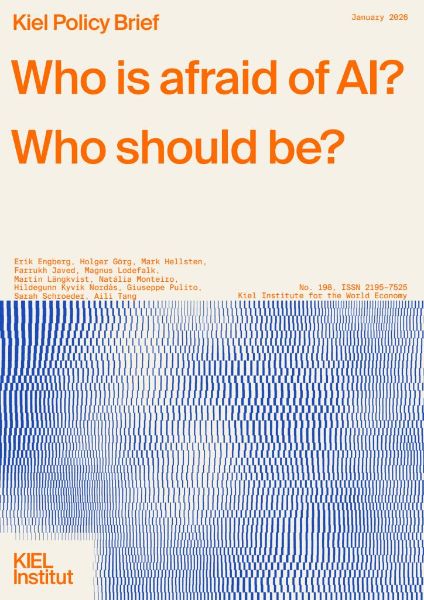
A recent policy brief by the Kiel Institute for the World Economy takes a more differentiated – and refreshingly evidence-based – view.

Here some insights from a knowledge management perspective:

  1. Exposure is not the same as replacement:
    One of the most important clarifications in the study is also one that is often missing in discussions: “Exposure to AI … indicates the potential applicability of AI to an occupation’s tasks — it is not inherently a measure of substitution or complementarity.”
    In other words:
    Just because AI can do parts of your work does not mean it will replace you.
    For knowledge work, this is a crucial distinction. Even in organisations where AI is already deeply embedded it does not necessarily reduce headcount. Instead, we see shifts in how work is done and what kind of knowledge becomes critical.
  2. Surprise(?): High-skilled knowledge workers are most exposed
    The study shows a pattern that is different from previous economic transformations: Highly cognitive, non-physical, low-social-interaction jobs (e.g. analysts, developers, translators) are most exposed to AI. Whereas, jobs requiring manual skills or intensive interpersonal interaction are least exposed.
    It is not the “low-skilled” jobs that are immediately most affected – it is classic knowledge work.
    From a KM perspective, these are precisely the domains where structured knowledge, explicit processes, and codified expertise already exist – making them easier for AI to engage with. Or following Willkes definition of knowledge work it is the knowledge-intense work (not the actual knowledge work).
  3. No (immediate) job loss – but skill shifts
    The empirical results across Denmark, Portugal, and Sweden are remarkably consistent:
    – No significant negative effect on total employment
    – Clear shift towards higher-skilled work (“skill upgrading”)
    Firms exposed to AI “raise their high-to-low skill employment ratios” and reallocate toward high-skill white-collar jobs.
    This fits closely with what many of us observe in practice:
    Routine documentation is automated, analytical work is accelerated. But interpretation, integration, and contextualisation become more important.
    Or, in KM terms: We are moving from information processing to meaning-making (from explicit to tacit).
  4. The overlooked dimension: social and tacit knowledge
    A particularly interesting methodological choice in the study is the inclusion of social skills as a counterweight to AI exposure:
    Social tasks are assumed to be more difficult to automate. This aligns strongly with long-standing KM insights:
    Tacit knowledge is hard to codify.
    Social interaction is key to knowledge creation (think SECI…).
    Context and trust cannot easily be replicated by systems.
    If you connect this to earlier discussions on this blog (e.g. on knowledge transfer during offboarding or peer-based formats like Peer Assist), a clear conclusion emerges:
    What protects jobs is not the absence of AI—but the presence of social, contextual, and experiential knowledge work.
  5. Not all AI is the same – and that matters
    Another important nuance in the study: Different AI subdomains have different effects. In particular: Language modelling, speech recognition, reading comprehension show positive associations with employment across all skill groups.
    This is highly relevant for organisations currently introducing generative AI: These systems are not only automation tools – they are collaboration technologies. They amplify communication, documentation, and coordination – core KM processes, if used correctyl and not as a Google 2.0.

What does this mean for knowledge management?

If we step back, the findings point to a shift in the KM agenda.

From:

  • Capturing knowledge
  • Structuring information
  • Reducing redundancy

To:

  • Enabling skill development
  • Supporting AI-augmented workflows
  • Strengthening social knowledge processes

Or more provocatively:
The real risk is not that AI replaces knowledge workers.
The real risk is that organisations fail to redefine knowledge work.

So, who should be afraid?

The answer from the study is clear: It depends on the tasks you perform.

Be concerned if your work is:

  • Highly standardised
  • Easily codified
  • Low in social interaction

Be optimistic if your work involves:

  • Interpretation and judgment
  • Cross-context integration
  • Collaboration and sensemaking

However, AI does not primarily eliminate work. It reshapes the skill profile of work. Which is not a surprise, is it?
But what are the implications for knowledge management?

  • We need better ways to develop and transfer higher-order skills.
  • We need to redesign knowledge processes for human–AI collaboration.
  • And we need to take tacit and social knowledge more seriously than ever.

Because in the end, the question is: Who is prepared to work differently with knowledge?

And another question that arises from this is: What does this mean for young people entering the workforce?
To be continued.

Das Münchner Haus des Wissens

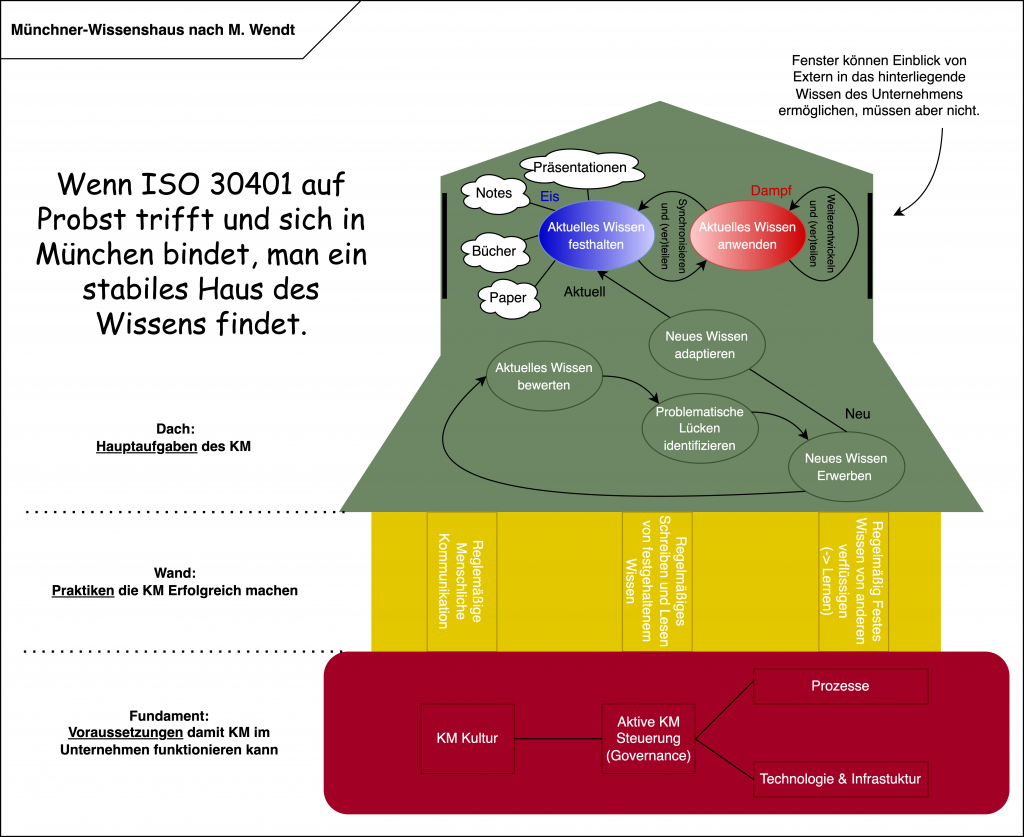
Wie im letzten Blogpost bereits berichtet, erstellen die Studierenden meiner Lehrveranstaltung Wissensmanagement-Modelle und -Strategien am Center for Advanced Studies der Dualen Hochschule Baden-Württemberg (DHBW) ein kurzes Erklärvideo oder ein Icon/ eine Visualisierung zu einem Konzept aus dem Wissensmanagement.

Maximilian Wendt ist dabei kreativ übers Ziel hinausgeschossen und hat anstelle einer einfachen Visualisierung gleich ein Modell für Wissensmanagement erstellt: sein Münchner Haus des Wissens (München, weil sich im oberen Stockwerk Anklänge an das Münchner Modell nach Reinmann finden). Andere Inspirationsquellen von Max finden sich im kleinen einleitenden Reim.

Auch dieses wunderbare Arbeitsergebnis dieser kleinen Studienaufgabe wollte ich euch nicht vorenthalten. Ich finde es sehr inspirierend. Vielen Dank, Max!

Unlearning vs Forgetting

Als so genannte Vorprüfungsleistung meiner Lehrveranstaltung Wissensmanagement-Modelle und -Strategien am Center for Advanced Studies der Dualen Hochschule Baden-Württemberg (DHBW) erstellen die Studierenden ein kurzes Erklärvideo oder ein Icon/ eine Visualisierung zu einem Konzept aus dem Wissensmanagement.

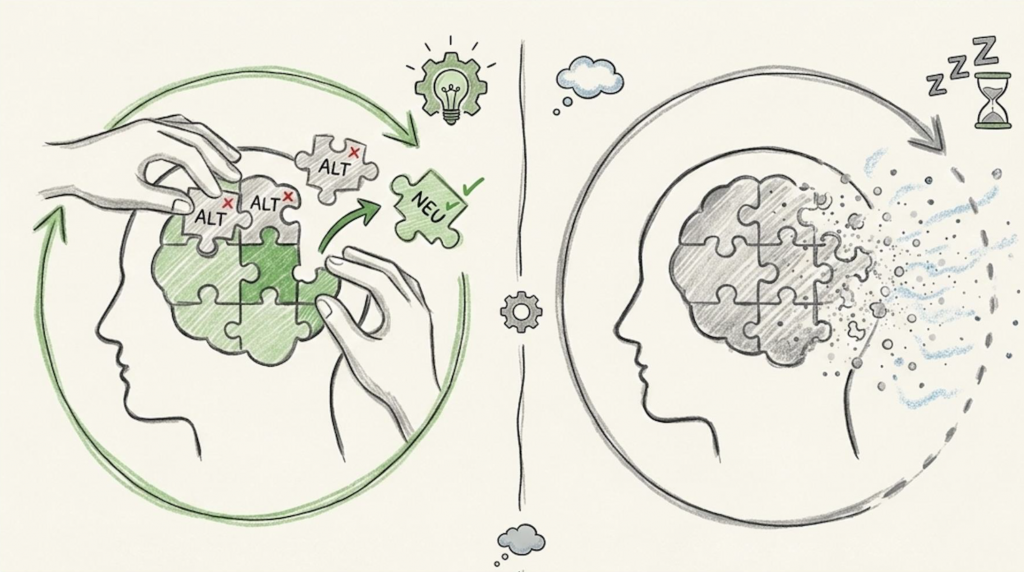
In diesem Semester haben Nils Weber und Maximilian Fetzer gemeinsam das Konzept der Unlearning Organisation visualisiert, und zwar im Gegensatz zur Forgetting Organisation. Das ist ihnen sehr gut gelungen, weshalb ich ihre Visualisierung hier gerne teile. Und weshalb ich nun auch gar nichts weiter zu den Konzepten Unlearning und Forgetting sage, weil sich dies aus dem Bild einfach erschließt.

Vielen Dank für die Erlaubnis zur Veröffentlichung, Nils und Max!